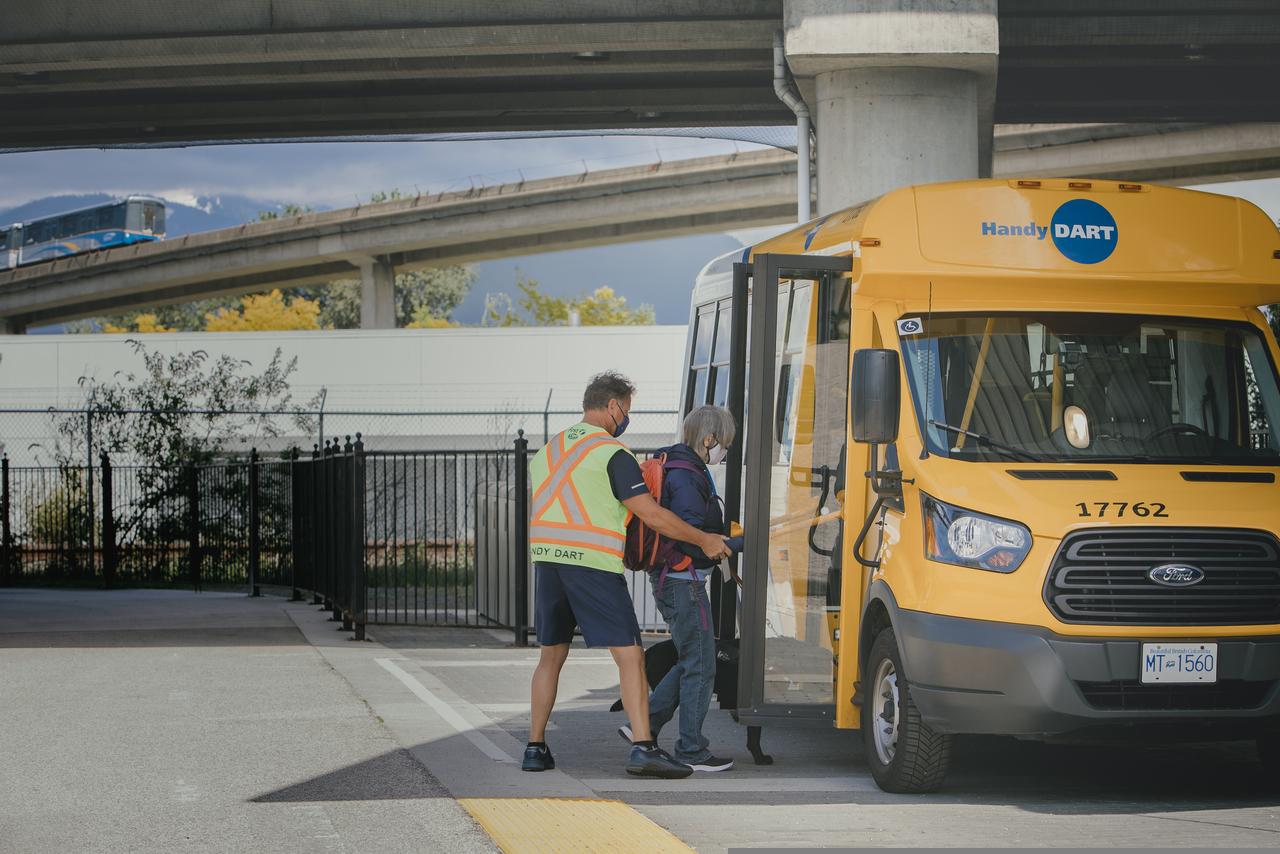
On June 27th, after eight months of contract negotiations, Metro Vancouver HandyDart workers with the Amalgamated Transit Union (ATU) voted yes to strike with a strong 95% margin and a 75% turnout. Since then, ATU members have been taking escalating job actions with the hope of pressuring their employer to agree to modest wage increases and a reasonable time period for a new collective agreement.
TransDev, the French corporation the BC government contracts to operate HandyDart, has been unresponsive to this gradual pressure campaign. On July 29th HandyDart workers started an overtime ban – the first job action of this struggle that could negatively affect HandyDart riders, and a full work stoppage strike seems likely.
The main issue in this strike is wages. Wages were also the main issue in the long Fraser Valley transit strike in 2023, a transit system that is also subcontracted to TransDev by the Province. After a four-month long strike, transit workers in the Fraser Valley won major wage increases: from $24 an hour for HandyDart drivers and $29 an hour for conventional bus drivers to $38 an hour each in 2025. HandyDart drivers in Metro Vancouver make $31 an hour. The best offer to date from Transdev would keep us making less than the drivers who work under them in the Fraser Valley, where the cost of living is significantly lower than in Metro Vancouver.
But if it’s all about money, why should passengers support this strike? What do the wages of transit worker have to do with the quality of service for HD passengers?
When ATU started negotiations with TransDev, the union’s central demand was “wage parity” with conventional transit bus drivers, who make nearly $10 an hour more than HandyDart paratransit drivers. This was a strong demand because it refused the idea that paratransit is less important or socially valuable than conventional, big-bus transit; a logic that stems from the devaluing of people with disabilities and elders that ride HandyDart. The fight for wage parity between paratransit and conventional transit workers is a fight for the rights and dignity of paratransit riders as well as drivers.
In a gesture of compromise that has not been reciprocated by TransDev, union negotiators dropped the more symbolically significant wage parity demand and backed down to asking instead for parity with bus drivers in the Fraser Valley. Even without the political salience of wage parity, the point still stands that low wages for paratransit operators devalues paratransit riders and the paratransit system. Low wages for HandyDart drivers, office workers, and mechanics through period of ATU’s next collective agreement will harm HandyDart riders because without higher wages, staffing shortages will never be corrected. As has already been the trend over the last couple years, more and more rides will be sub-contacted again to taxis, which are not equipped to safely transport most HandyDart riders.
There is now an institutional crisis of staffing shortages at HandyDart. Dozens of drivers left HandyDart during the Covid pandemic shutdowns when casual drivers were laid off. Many took other jobs and then did not come back when the restrictions were lifted.
The company has been unable to replace these drivers and meet needed staffing levels because of high turnover. HandyDart has a turnover rate of roughly double the rate of the Coast Mountain-run conventional bus system. Some drivers leave because they can’t get out of the casual pool into a full time run that works for them, but most leave because the pay at HandyDart is too low.
Translink and TransDev know all of this. At every Translink board meeting since governments lifted pandemic restrictions, the report on HandyDart has said too many trips are being diverted to taxis. And at every meeting, Translink board members have said TransDev (and before that, First Transit) were dealing with it by increasing hiring efforts – with hiring fairs and streamlining training and testing for the class 4 license… doing everything but raising wages. Having more busses on the road is the solution to the problem of increasing sub-contracting to taxis. And higher wages is the solution to the problem of understaffing that keeps those busses from the road.
But at a bargaining meeting in the spring, TransDev’s negotiators told the union that they’re “not losing any sleep” over the problems of high driver turnover, low retention rates of new drivers, and resulting understaffing. It seems that TransDev is more than happy to sub-contract HandyDart services further to taxi companies. TransDev’s financial books are closed because it is a private company (in France!), but its actions suggest that they save money by hiring on-demand taxis to fill gaps in HandyDart scheduling rather than by putting more regular busses on the road. They are, after all, a for-profit, private company that knows how to cut costs to fill the pockets of their investors. According to their year end financial report to investors, TransDev posted a 23million euro net income in 2023.
A fact of ATU’s experience with TransDev is that this company only hears workers when we speak with action. This echoes the experiences of transportation workers in nineteen countries around the world, whose public transit systems have been contracted out to this monopolist corporation, and who have waged determined strikes to defend their rights and win livable wages. But while job actions by HandyDart workers can have devastating effects on HandyDart riders in the short term, whether by overtime refusals, restricted customer service by dispatchers, or total work stoppage and picket lines, these actions are part of a struggle for a better HandyDart overall, for both workers and riders.
As TransDev’s stubborn refusal to sign a new contract with decent wages drives ATU closer to a full strike, tensions may arise with HandyDart riders who, alongside striking workers, will suffer privations when busses stop running. Some HandyDart runs are covered by essential service designations, so passengers travelling to renal, cancer, and MS treatments will still receive bus service. But others may be stranded.
How can HandyDart drivers and riders turn divisions caused by hardship into unity in a common struggle for a more just HandyDart?
A relatively easy and accessible action that supporters of ATU’s job actions can take is to call the Translink head office and tell them to direct TransDev to meet ATU’s current contract demands for wage parity with BC Transit in the Fraser Valley, and to limit the next collective agreement to 3 years. The Translink head office number is: 778-375-7500
And if the strike escalates, there may be opportunities for common direct action, like when HandyDart riders protested at a Translink board meeting during the 2009 strike. In this struggle the connection between worker’s rights and social justice are clear – the fight for a just HandyDart unites workers and riders as one.
(*Download this article as printable leaflet here)